skip to content
jasondank.com/projects/humanauth

Projects / 2026 · 2 of 13

HumanAuth

Replacing CAPTCHA with Real-Time Computer Vision

LIVE · WEBSOCKETLIVENESS CHECKSMicro-movement3D facial consistencyBlink patternTexture analysisGesture challengeHand trackingHuman verified · 3.3s
Face landmarks tracked from the webcam while the six liveness checks pass one by one

What it does

  • Senior capstone with Jack Denholm: a web-based biometric system that tells humans from automated agents in real time, using continuous behavioral analysis instead of static challenge solving.
  • An Angular front end streams webcam frames over a persistent WebSocket to a Python Flask backend, where MediaPipe face and hand landmark models feed six complementary liveness checks — micro-movement, 3D facial consistency, blink patterns, texture analysis, gesture challenge-response, and hand tracking.
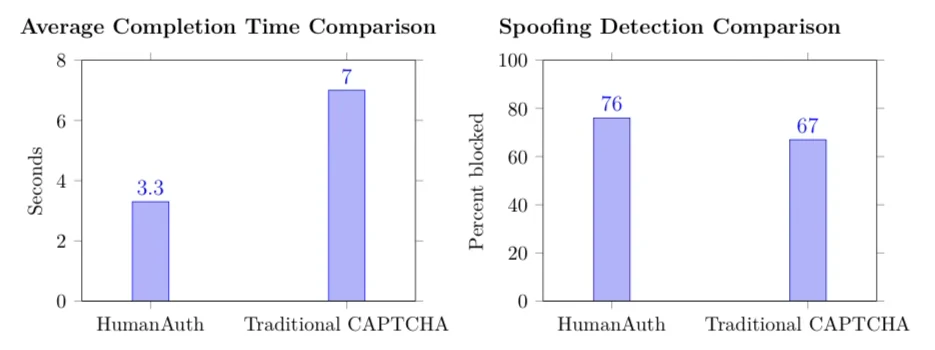
  • Across 50 trials with four participants: 3.3s average completion against 7.0s for traditional CAPTCHA, a 92% authentication success rate against 80%, and 76% of simulated presentation attacks blocked against 67%.

What I'm proudest of

We beat traditional CAPTCHA on both speed and accuracy, and the six liveness checks blocked more spoofing attempts than it did. Taking our capstone all the way to a written research paper with Jack is what I’m proudest of.

Screenshots
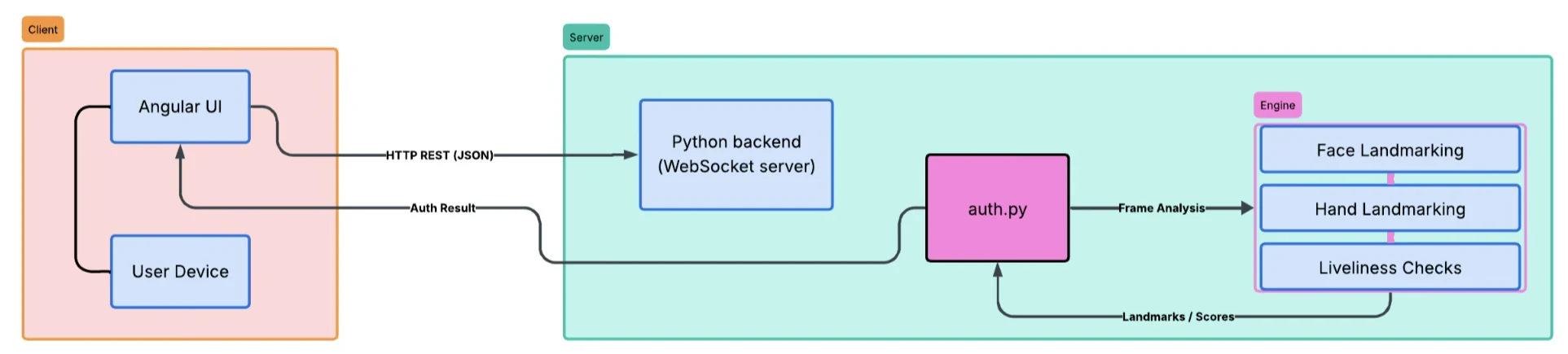
System architecture from the paper: the Angular client sends frames to the Python WebSocket backend, where auth.py runs face landmarking, hand landmarking and the liveness checks, and returns the result
Results from the paper: 3.3 s average completion against 7 s for traditional CAPTCHA, and 76% of spoofing attempts blocked against 67%